
iPhone 15 Pro Max: Spyware Detection & Forensic Analysis
The iPhone 15 Pro Max represents the pinnacle of Apple's consumer security architecture. With its A17 Pro chip and hardened Secure Enclave, it is marketed as virtually impenetrable.
iPhone 15 Pro Max: What Makes It a Target
The iPhone 15 Pro Max represents the pinnacle of Apple's consumer security architecture. With its A17 Pro chip and hardened Secure Enclave, it is marketed as virtually impenetrable.
When individuals, executives, or journalists suspect their iPhone 15 Pro Max is compromised, the threat model instantly shifts from amateur stalkerware to highly sophisticated, nation-state-level mercenary spyware.
Investigating this device requires the most advanced forensic techniques available, as standard commercial extraction tools frequently fail against its modern encryption protocols.
iPhone 15 Pro Max Security Architecture
The security architecture of the iPhone 15 Pro Max is formidable. At its core is the Secure Enclave Processor (SEP), a dedicated subsystem completely isolated from the main processor. The SEP handles all cryptographic operations, Face ID data, and keychain management.
The device utilizes File-Based Encryption (FBE) via APFS (Apple File System). Every file is encrypted with a unique key, and those keys are further wrapped by class keys derived from the user's passcode and the device's hardware UID.
Furthermore, the A17 Pro chip introduces advanced memory protections (PAC - Pointer Authentication Codes) that make exploiting the kernel exponentially more difficult, actively thwarting zero-day memory corruption attacks.
From a forensic perspective, if the iPhone 15 Pro Max is in a 'Before First Unlock' (BFU) state (powered off and not yet unlocked with a passcode), the user data is entirely inaccessible. The cryptographic keys required to decrypt the `sms.db` or third-party app sandboxes simply do not exist in the system memory.
- Secure Enclave (SEP): Hardware-level isolation for cryptographic keys and biometrics.
- File-Based Encryption (APFS): Granular, per-file encryption derived from the user passcode.
- Pointer Authentication Codes (PAC): Hardware-level mitigations against memory corruption exploits.
- Lockdown Mode: An optional extreme protection mode that aggressively restricts web parsing and message rendering.
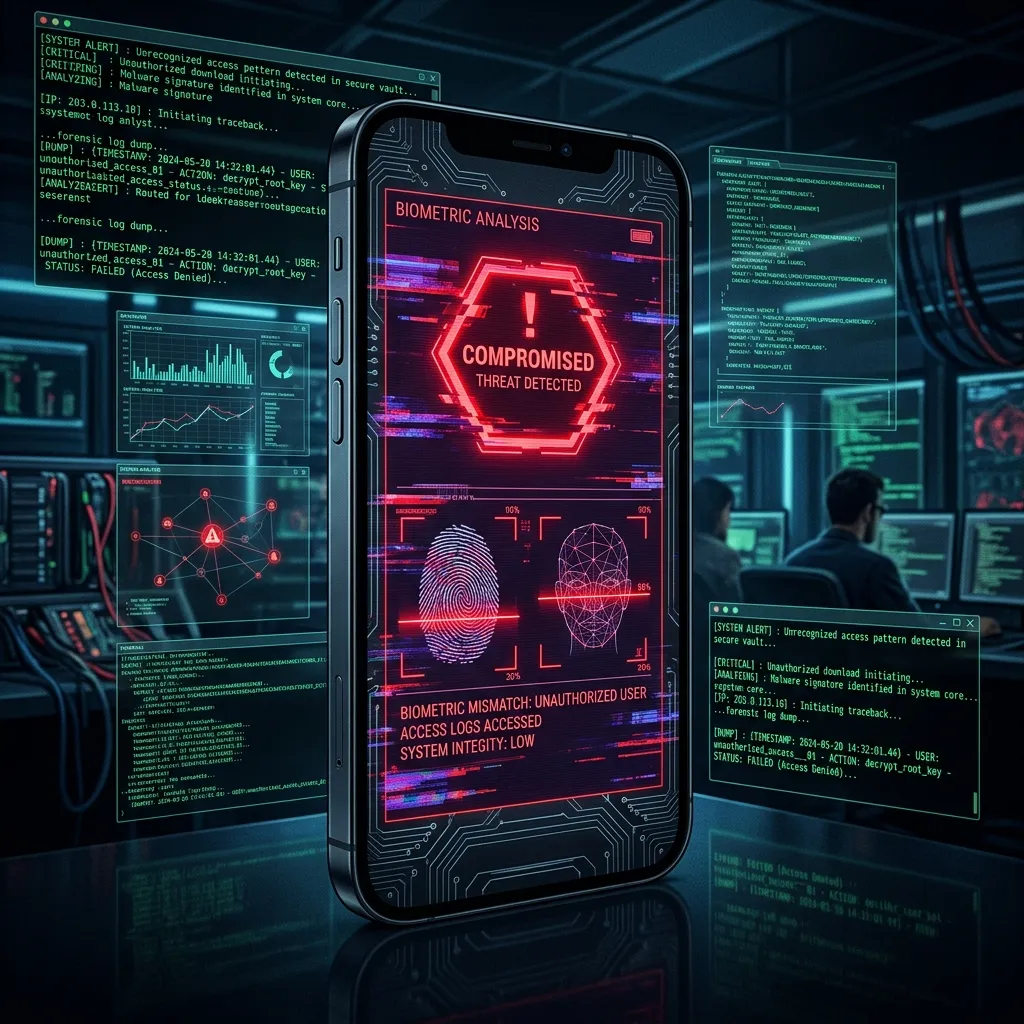
Forensic Analysis Capabilities for iPhone 15 Pro Max
Forensic capabilities on the iPhone 15 Pro Max are highly contingent on the device state (BFU vs. AFU) and the iOS version.
Logical Extraction: If the passcode is known, we can perform an Advanced Logical Extraction. This utilizes the Apple File Relay service (via iTunes backup protocols) to pull the active SQLite databases, photos, and app preferences. However, this method will not extract deleted data from unallocated space.
Full File System (FFS): Achieving an FFS extraction on an iPhone 15 Pro Max requires a highly privileged exploit. Because the device is immune to the historic `checkm8` bootrom exploit, we must rely on transient kernel vulnerabilities (which are constantly patched by Apple).
Spyware Triage: If a Full File System extraction is impossible due to the iOS version, we can still perform a highly effective spyware triage. We utilize the `sysdiagnose` logs, the `DataUsage.sqlite` database, and the `Shutdown.log` to identify the anomalous network signatures and process injection techniques utilized by elite spyware like Pegasus or Predator.
Common Threats Targeting This Device
Because amateur stalkerware cannot easily bypass the strict sandboxing of iOS 17, the primary threats targeting the iPhone 15 Pro Max are sophisticated.
Zero-Click Exploits: Mercenary spyware (like Pegasus) utilizes zero-click vectors, sending a malformed iMessage or a hidden HomeKit invitation that exploits a vulnerability in the background without any user interaction.
iCloud Compromise: The most common 'hack' is not a device exploit, but an iCloud account takeover. If an attacker gains access to the Apple ID, they can silently sync iMessages, photos, and location data to a secondary device.
MDM Abuse: Mobile Device Management (MDM) profiles, often used by corporations, can be weaponized. If a user is tricked into installing a malicious configuration profile, the attacker gains massive control over the device, including the ability to route traffic through a proxy server.
Our Assessment Approach
Our investigation begins with a non-destructive logical analysis. We immediately pull the `sysdiagnose` logs to hunt for zero-click spyware indicators of compromise (IOCs).
We audit the device's configuration profiles, VPN settings, and Apple ID 'Trusted Devices' list to rule out persistent administrative abuse.
If the case requires the recovery of deleted communications and the iOS version permits, we coordinate with specialized intelligence partners to deploy advanced, transient kernel exploits to achieve a Full File System extraction, allowing us to carve the SQLite databases for destroyed artifacts.
Frequently Asked Questions
Related Recovery Services
$ Open a secure channel via Session. Pre-engagement NDA available on request. Ready to proceed?
[ INITIATE SECURE CONTACT ]