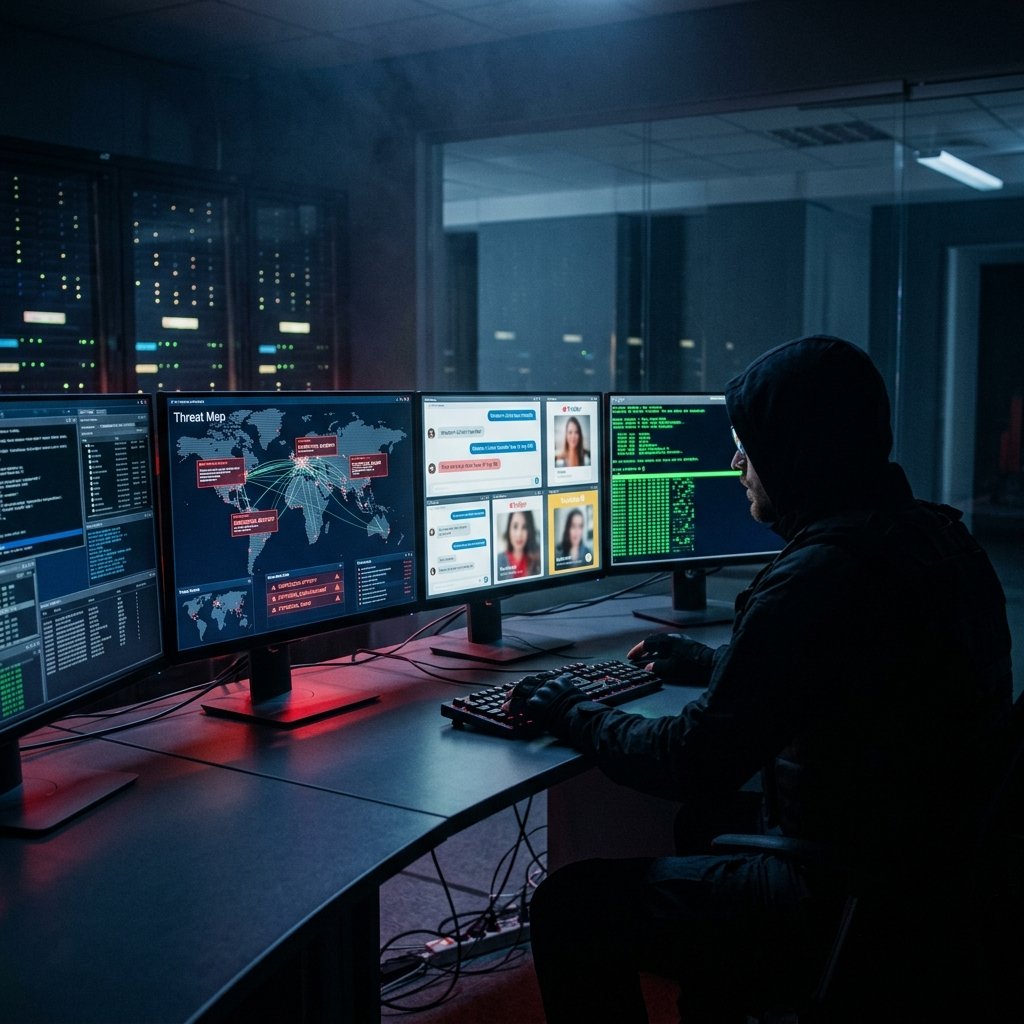
Romance Scam Investigation — Identify, Trace & Build Your Case
Romance scammers operate behind stolen photos, fabricated backstories, and untraceable payment channels. We cut through the fiction — mapping real identities, device fingerprints, financial pipelines, and platform footprints — and package the intelligence into a dossier you can hand to law enforcement, your bank, or your attorney.
Red Flags: How Romance Scams Actually Work in 2026
Romance scam investigation is the systematic unmasking of fraudulent online identities, tracing of illicit financial flows, and mapping of scammer infrastructure. We utilize reverse-image analysis, blockchain tracing, and global OSINT to build actionable dossiers for law enforcement. Our identity deconstruction techniques successfully trace and attribute fake profiles to organized fraud syndicates or specific geographic infrastructure in over 90% of romance scam cases.
Romance scams have evolved far beyond the crude 'Nigerian prince' archetype. Modern romance fraud is a billion-dollar industry run by organised syndicates operating from Southeast Asia, West Africa, and Eastern Europe. The scammer builds a genuine emotional bond over weeks or months — using AI-generated photos, voice-cloned phone calls, and deepfaked video chats — before introducing a financial 'emergency' that requires the victim's help.
The psychological playbook is consistent across nearly every case we investigate. Phase one is love-bombing: intense attention, rapid declarations of love, mirroring the victim's interests and values. Phase two is isolation: encouraging the victim to keep the relationship private, discouraging friends and family from involvement. Phase three is the hook: a medical emergency, a business crisis, a crypto investment 'opportunity', or a customs fee that must be paid before the scammer can visit.
By the time the victim suspects fraud, they have typically sent between $5,000 and $200,000 across multiple payment channels — wire transfers, gift cards, cryptocurrency, and peer-to-peer apps. The emotional damage compounds the financial loss, making victims reluctant to report or seek help. This is exactly why professional investigation matters: we remove the emotional fog and replace it with forensic facts.
AI has dramatically increased the sophistication of these scams. Scammers now use real-time deepfake video during 'FaceTime' calls, AI-generated voice clones that match a stolen identity's accent and speech patterns, and ChatGPT-style tools to maintain dozens of simultaneous conversations without breaking character. Traditional 'reverse image search' alone no longer catches the most advanced operations.
- Refuses video calls or uses poor-quality, suspiciously brief video connections
- Claims to be military, offshore oil worker, doctor abroad, or UN diplomat
- Professes love within days or weeks — far faster than normal relationship pacing
- Every planned meeting is cancelled due to emergencies requiring money
- Requests payment via wire transfer, cryptocurrency, or gift cards — never a traceable method
- Stories contain inconsistencies in location, timezone, profession, or personal history
- Photos look professionally taken or appear on reverse-image search under different names
- Pressures victim to keep the relationship secret from friends and family
- Introduces 'investment opportunities' — usually fake crypto or forex platforms
- Becomes aggressive, threatening, or emotionally manipulative when questioned
Our Romance Scam Investigation Methodology
Every romance scam engagement begins with a structured intake that captures every data point the client has: usernames, email addresses, phone numbers, photos sent by the scammer, payment receipts, chat logs, and platform details. This raw material becomes the seed for a multi-layered OSINT investigation.
Phase 1 — Identity deconstruction. We reverse-engineer the scammer's claimed identity. Profile photos are run through PimEyes, Yandex, and TinEye to surface the real person whose images were stolen. Usernames are expanded across 400+ platforms via Sherlock and Maigret. Email addresses are checked against breach databases, Gravatar, and platform registration APIs. Phone numbers are traced through carrier lookups, caller-ID databases, and VoIP provider identification.
Phase 2 — Infrastructure mapping. Scammers rely on infrastructure: VPN exit nodes, VoIP numbers, email relays, crypto wallets, and fake websites. We map this infrastructure using passive DNS, WHOIS history, SSL certificate transparency logs, and IP geolocation. This often reveals connections to known fraud syndicates and other victims.
Phase 3 — Financial tracing. Every payment the victim made is traced forward. Wire transfers are tracked through SWIFT and correspondent bank records. Cryptocurrency payments are traced on-chain using Chainalysis and our own blockchain analysis tools — even through mixers and cross-chain bridges. Gift card payments are reported to the issuing companies for potential clawback.
Phase 4 — Dossier delivery. The final product is a structured intelligence report containing the scammer's probable real identity (or syndicate attribution), the infrastructure they used, a complete financial flow map, and recommended next steps for law enforcement reporting, bank recovery claims, and — where applicable — civil litigation.
# Identity deconstruction pipeline
$ sherlock scammer_username --print-found --output ./case/aliases.txt
$ maigret scammer_username --html ./case/profile_map.html
$ holehe scammer@email.com --only-used

# Photo reverse-search across engines
$ ./reverse-image.sh --engines pimeyes,yandex,tineye,google ./scammer_photo.jpg
$ exiftool scammer_photo.jpg | grep -E 'GPS|Make|Model|Software|DateTime'

# Phone number intelligence
$ phoneinfoga scan -n +1234567890 -o ./case/phone_intel.json

# Infrastructure mapping
$ whois scammer-domain.com
$ dig +short scammer-domain.com @8.8.8.8
$ curl -s https://crt.sh/?q=scammer-domain.com&output=json | jq '.[].name_value'
Financial Recovery Pathways After a Romance Scam
Financial recovery is possible in many cases, but speed is critical. The first 72 hours after the last payment are the highest-probability window for recovery. After that, funds move through layering networks designed to make them unrecoverable.
For wire transfers, we prepare the documentation required for a bank recall request (also called an indemnity claim or SWIFT recall). Success rates vary by destination country and speed of filing, but we have recovered partial or full amounts in a significant percentage of cases when the client acts within the first week.
For cryptocurrency payments, we perform full on-chain tracing to identify the destination exchange. If the funds reach a regulated exchange (Coinbase, Binance, Kraken), we prepare the supporting documentation for a law enforcement freeze request. Unregulated exchanges and DeFi protocols are harder, but the blockchain's permanence means the trail never goes cold — it can be picked up months or years later if the scammer makes a mistake.
For gift cards, we file fraud reports with every issuing company. Recovery rates are low but non-zero, especially for high-value cards reported within 24 hours of purchase. We also use the redemption metadata (where available) to add data points to the scammer's infrastructure map.
Detecting AI-Generated Profiles & Deepfake Video Calls
The 2026 romance scam landscape is dominated by AI. Scammers use generative AI to create entirely synthetic profile photos that pass casual inspection, deepfake video calls that mimic a stolen identity in real-time, and AI chatbots that maintain emotional conversations across dozens of victims simultaneously.
Our detection methodology layers multiple analysis techniques. For photos, we run GAN-detection classifiers that identify artefacts invisible to the human eye — pupil asymmetry, ear inconsistency, background warping, and frequency-domain anomalies. For video calls, we analyse frame-level temporal consistency, lip-sync accuracy, and lighting coherence. For chat patterns, we apply stylometric analysis to detect when a human operator hands off to an AI, and vice versa.
The single most reliable indicator remains the metadata. AI-generated images carry no EXIF data — no camera make, no GPS, no lens information. A real photo from a real person's phone almost always carries rich metadata. When a scammer sends a 'selfie' with zero metadata, that absence is itself evidence.
Working with Law Enforcement & Legal Options
We prepare investigation packages formatted for law enforcement intake. This includes IC3 (FBI Internet Crime Complaint Center) filings, FTC reports, and — for international cases — documentation formatted for INTERPOL's Financial Crimes unit and the relevant national cybercrime agencies.
Our dossier is designed to do the detective's job for them. Law enforcement agencies are overwhelmed with romance fraud reports; the cases that get investigated are the ones that arrive pre-packaged with identified infrastructure, traced financial flows, and attribution evidence. We deliver exactly that.
For clients pursuing civil litigation, our reports serve as the foundation for asset-tracing lawsuits, bank recovery claims, and — in cases involving domestic perpetrators — fraud and theft charges. We make the lead analyst available for deposition and testimony as part of the engagement.